
Repiping a DeWitt House When the Record Says Almost Nothing
1,974 of DeWitt's 2,036 recorded service lines are unknown, so the pipe in your walls has to be judged on the house rather than on the paperwork.
Repiping quote in DeWitt
Share a few details so we can confirm coverage and arrange the right next step.
Would you rather talk it through? Call (315) 640-3590, answered 24/7.
$100 off your first job
Credited by us on your first booked job.
- One credit per customer per property, on your first booked job.
- Valid through December 31, 2026.
Mention this offer when you book. Full terms.
DeWitt build years against an almost empty pipe record
American Community Survey 2020 to 2024 five year estimates give the town of DeWitt a median year of construction of 1963 across 10,996 housing units, with 2,054, or 18.7 percent, built in 1939 or earlier, 24.5 percent before 1950, and 8,336, or 75.8 percent, before 1980. The New York State Lead Service Line Inventory records 2,036 lines under the locality DeWitt with no confirmed lead or galvanized lines and 1,974 unknown, and 878 under Town of Dewitt with 1 lead, 2 galvanized requiring replacement and 631 unknown.
Source: US Census Bureau, accessed 2026-09-13
OCWA's 2024 water source table lists the town of DeWitt as receiving water from Otisco Lake, Lake Ontario or Skaneateles Lake, one of only two municipalities in Onondaga County given three sources, the other being the town of Geddes. The City of Syracuse separately reports supplying water to portions of the town of DeWitt under wholesale and service agreements.
Source: Onondaga County Water Authority, accessed 2026-09-13
Section 305.4 of the Plumbing Code of New York State, headed Freezing, states that water, soil and waste pipes shall not be installed outside a building, in attics or crawl spaces, concealed in outside walls, or in any other place subject to freezing temperatures unless adequate provision is made to protect them by insulation or heat or both, and that exterior water supply system piping shall be installed not less than 6 inches below the frost line and not less than 12 inches below grade.
Source: UpCodes, publishing the Plumbing Code of New York State 2020, accessed 2026-09-13
Section 5.5.B of the Onondaga County Requirements for Implementation states that all newly installed lines carrying potable water, and parts of existing systems that have been altered, extended or repaired, shall be disinfected before use. Section 5.5.H requires that where a water service is removed or relocated, the former pipe or sleeve is capped at the inside and outside walls and any openings grouted full, and 5.5.I requires a discontinued service to be exposed at the curb stop, disconnected, capped at the valve outlet and inspected by the water purveyor.
Source: Onondaga County Examining Board for Plumbers, accessed 2026-09-13
OCWA publishes a Service Material Inventory Map where a customer can enter an address and see the service line material OCWA holds on record for that property. Where the record is unknown, OCWA asks for color photographs of the water service pipe where it comes into the building and the portion up to the meter, submitted through an online form, and offers a five minute home visit by an OCWA employee to help identify the material, arranged on 315-455-7061 extension 3139.
Source: Onondaga County Water Authority, accessed 2026-09-13
A town with a 1963 median and almost no pipe record
DeWitt has a median year of construction of 1963 across 10,996 housing units, with 18.7 percent built in 1939 or earlier and 75.8 percent before 1980. That spread covers prewar streets and postwar subdivisions in the same town, so age alone does not settle the question here. Nor does the inventory: 2,036 lines are recorded under the DeWitt locality with 1,974 of them unknown and nothing confirmed as lead or galvanized. In this town the pipe has to be looked at rather than inferred.
What to establish before agreeing a repiping scope
Start at the wall rather than at the record. The pipe where the service enters and the first few feet of the basement main tell you the era of the plumbing, and galvanized, copper with lead solder, copper with lead free solder and plastic all behave and fail differently. Then compare static pressure at a hose bib against flow at the fixture that complains, because the gap between those two numbers is the diagnosis. With almost nothing identified at the curb here, that hands on evidence is worth more than any inference from the year the house was built.
Prewar and postwar DeWitt are different houses
Nearly one home in five here predates 1940 while three quarters predate 1980. A blanket assumption about original galvanized runs fits the older streets and misses the subdivisions entirely, which is why the scope has to come from the pipe.
Keep new runs out of exterior walls
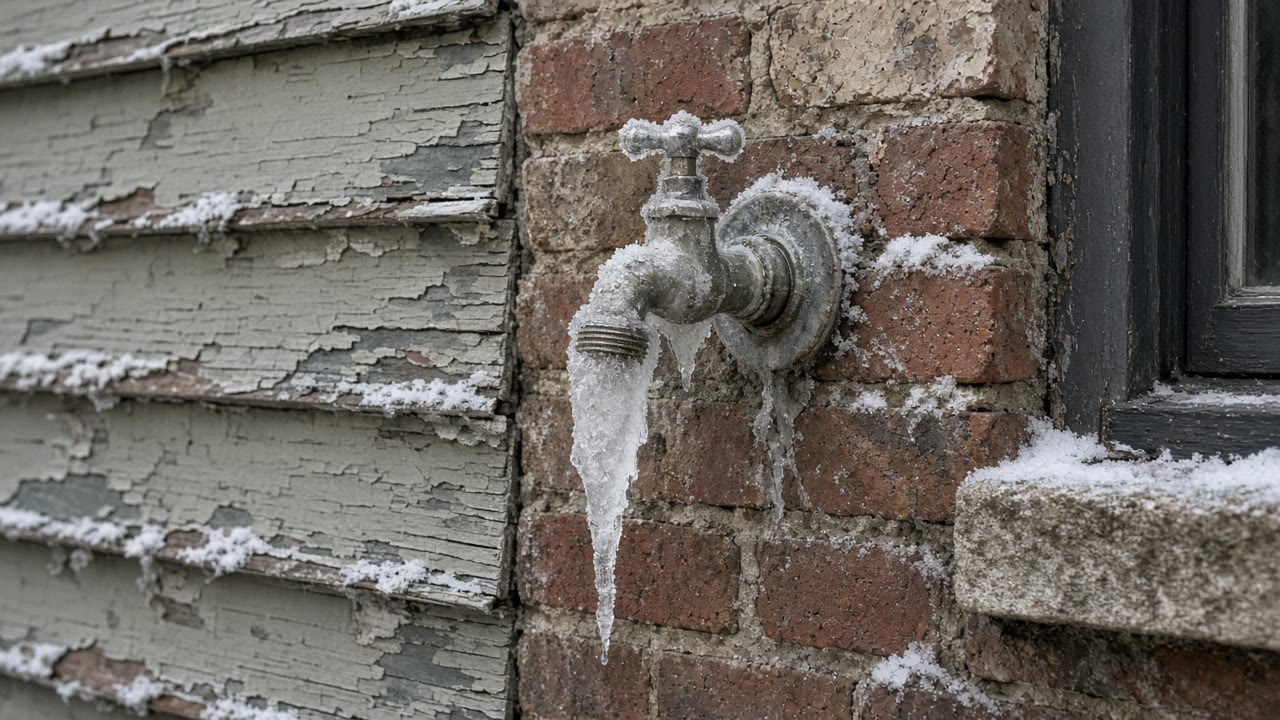
The state plumbing code says water pipe shall not be installed outside a building, in attics or crawl spaces, concealed in outside walls or anywhere subject to freezing unless protected by insulation or heat. Rerouting during a repipe is the cheapest moment to fix that.
Disinfection is part of the job
The county requires all newly installed potable lines, and any part of an existing system that has been altered, extended or repaired, to be disinfected before use. It rarely appears in a quote and it is a fair question when two prices look the same.
What is the pipe on your basement wall made of?
A photograph of where the service enters usually answers most of this. Send it with the address.
Other work we arrange in DeWitt
Repiping questions from DeWitt homeowners
The inventory says unknown for my street. How do I find out what I have?
Look at the pipe rather than the file, because in DeWitt the file is mostly empty: 1,974 of the 2,036 lines recorded under this locality are unidentified. The service pipe where it enters the basement, and the first few feet of the horizontal main, tell you the era directly. Galvanized steel is dull gray and magnetic, copper is obvious, and plastic is unmistakable. Photographs of that pipe are also what the authority asks for to resolve an unknown record, so one look answers the inside question and the outside question at once.
Half my house was remodeled in the nineties. Do I still need a whole house repipe?
Almost certainly not, and in a town with this spread of build years that is a common situation. Where a bathroom or kitchen was redone in the nineties, that branch is already copper and does not need doing twice. The honest scope is the original runs plus whatever the newer work ties into, which in a 1963 house is often the horizontal main and the risers to one bathroom rather than every wall in the building. Ask for the scope to be described that way rather than as a single whole house figure.
Tell us what the water does in your DeWitt house
Flow that faded, rust in the morning, or one floor that never had pressure. No obligation either way.