
Repiping a Skaneateles Village House From 1938 or Earlier
With the lead question already answered in this town, the interesting pipe is the pipe inside the walls.
Repiping quote in Skaneateles
Share a few details so we can confirm coverage and arrange the right next step.
Would you rather talk it through? Call (315) 640-3590, answered 24/7.
$100 off your first job
Credited by us on your first booked job.
- One credit per customer per property, on your first booked job.
- Valid through December 31, 2026.
Mention this offer when you book. Full terms.
Village and town build years, and a clean pipe record
American Community Survey 2020 to 2024 five year estimates give the Village of Skaneateles a median year of construction of 1938 with 735 of 1,353 units, or 54.3 percent, built in 1939 or earlier, and the surrounding town a median of 1956 with 1,278 of 3,492 units, or 36.6 percent, pre 1940. In the town, 8.8 percent of households heat with fuel oil and 11.5 percent with bottled or LP gas, a combined 20.3 percent, the highest share off natural gas of the sixteen towns in this metro.
Source: US Census Bureau, accessed 2026-09-13
The New York State Lead Service Line Inventory records 3,334 service lines under the locality Skaneateles with zero confirmed lead service lines, 14 galvanized requiring replacement, 3,145 non lead and 175 unknown, plus 49 further records under Town of Skaneateles with no lead. At 94 percent identified and nothing confirmed as lead, Skaneateles has both the most complete inventory and the cleanest result of any locality in the Syracuse metro.
Source: New York State Department of Health, accessed 2026-09-13
Section 305.4 of the Plumbing Code of New York State, headed Freezing, states that water, soil and waste pipes shall not be installed outside a building, in attics or crawl spaces, concealed in outside walls, or in any other place subject to freezing temperatures unless adequate provision is made to protect them by insulation or heat or both, and that exterior water supply system piping shall be installed not less than 6 inches below the frost line and not less than 12 inches below grade.
Source: UpCodes, publishing the Plumbing Code of New York State 2020, accessed 2026-09-13
The NOAA 1991 to 2020 annual climate normals for Syracuse Hancock International Airport, station USW00014771, give 132.5 days a year with a minimum temperature at or below 32 degrees Fahrenheit, 57.3 days at or below 20, and 7.7 days at or below zero. They also give 46.8 days a year on which the maximum temperature never rises above 32 degrees. The winter mean minimum is 19.2 degrees.
Source: NOAA National Centers for Environmental Information, accessed 2026-09-13
To obtain a homeowner plumbing permit in Onondaga County the applicant must apply in person, complete and sign a Homeowner Plumbing Permit Request form, furnish proof of ownership and that the home is an owner occupied single family dwelling, submit the New York State Workers Compensation Board form WC/DB-100 affidavit, submit plans showing all drainage and vent lines piped and sized to code, be prepared to answer questions on piping materials, fittings, tub and shower faucets, solder and inspection procedures, and pay the current permit and plan review fees. Any piping to be concealed must be inspected before covering, and a final inspection follows completion.
Source: Onondaga County Department of Water Environment Protection, accessed 2026-09-13
Where the money goes when the service line is settled
Skaneateles village shares the oldest median year of construction in this metro at 1938, with 735 of its 1,353 units, 54.3 percent, built in 1939 or earlier, while the surrounding town runs a median of 1956 with 36.6 percent pre 1940. Because the town's service line record is the cleanest here, with no confirmed lead across 3,334 lines, the attention naturally moves indoors, to supply piping and fixtures that in a village house are frequently as old as the house itself.
What actually justifies opening a wall in a village house
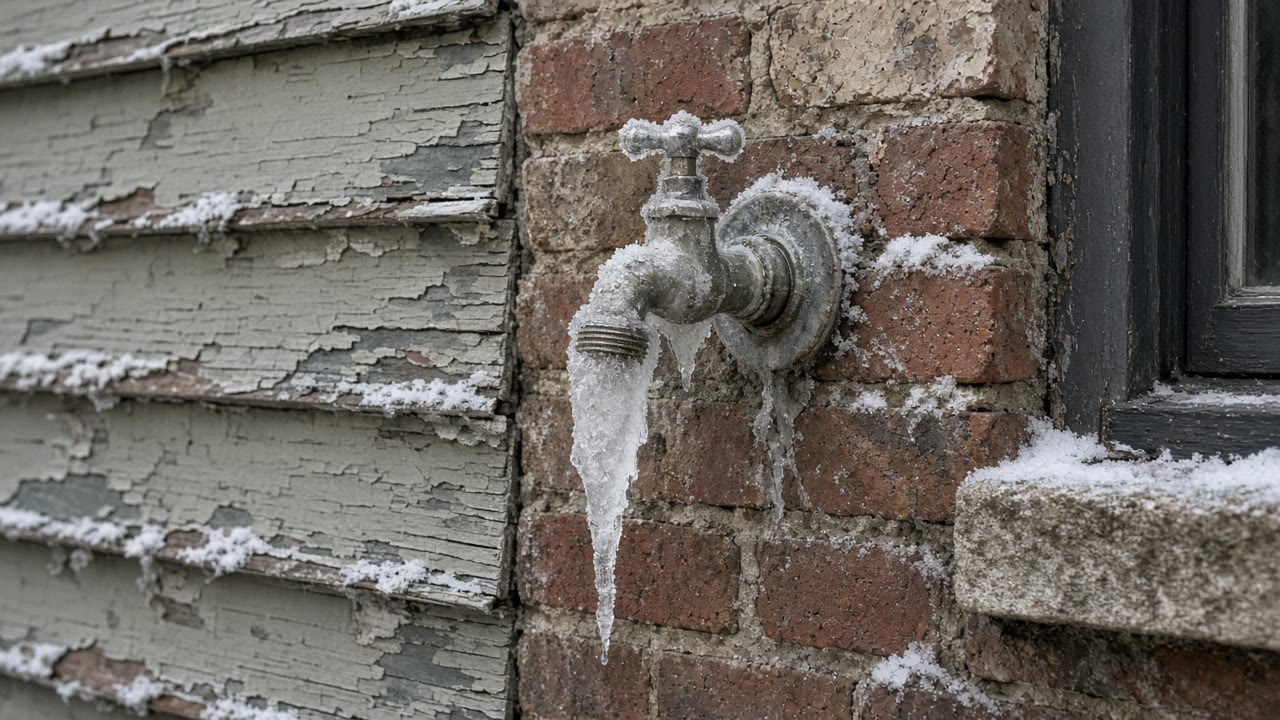
Flow, not age. Good static pressure at an outside hose bib with poor flow at the furthest fixture is a bore that has closed up, and that is the case for replacement. Sound flow in an old house is not a reason to repipe, whatever the build year says. The other genuine reason here is location: the state code says water pipe shall not run in attics, crawl spaces, exterior walls or anywhere subject to freezing unless protected, and in a lakeside village with 46.8 days a year that never rise above freezing, that is not an abstract rule.
Old does not mean failing
More than half this village predates 1940 and plenty of those houses have perfectly adequate flow. A repipe earns its cost where the flow has genuinely gone or where the walls are open anyway for another reason.
A seasonal house is a different brief
Pipe in a property that is left cold for part of the year needs routing and isolation planned around that, not just sizing. Where the house will be unheated, the water has to be dealt with deliberately rather than hopefully.
Inside the wall, a homeowner permit is available
Onondaga County issues homeowner plumbing permits for owner occupied single family dwellings, with an in person application, proof of ownership, the state WC/DB-100 affidavit and plans. Only the individual homeowner may install the work, and the inspection comes before anything is closed in.
Faded flow, or just an old house?
Those are different findings. Tell us what the furthest tap does and we will say which you have.
Other work we arrange in Skaneateles
Repiping questions from Skaneateles homeowners
My village house is from the 1930s. Does it need repiping on principle?
No, and it is worth resisting that argument when it is made to you. The village median year of construction is 1938 with 54.3 percent of homes built in 1939 or earlier, so age alone describes most of the housing stock here rather than picking out a problem. What justifies the work is flow that has faded at the furthest fixture while pressure at the hose bib remains sound, rust from the cold side after the water has stood, or walls that are open for another reason. Absent those, the pipe is doing its job.
Should supply pipe be rerouted in a house we leave cold in winter?
It is usually the most valuable part of the job. The state plumbing code says water pipes shall not be installed outside a building, in attics or crawl spaces, concealed in outside walls, or anywhere subject to freezing unless adequate provision is made by insulation or heat or both. In this town, with 132.5 days a year at or below freezing and 46.8 on which it never rises above, a run in an exterior wall of a seasonally heated house is the failure waiting to happen. Moving it while a wall is already open costs very little.
Tell us what the pipe does in your Skaneateles house
Weak at the far fixture, rust after standing, or a run in a cold wall. No obligation either way.